
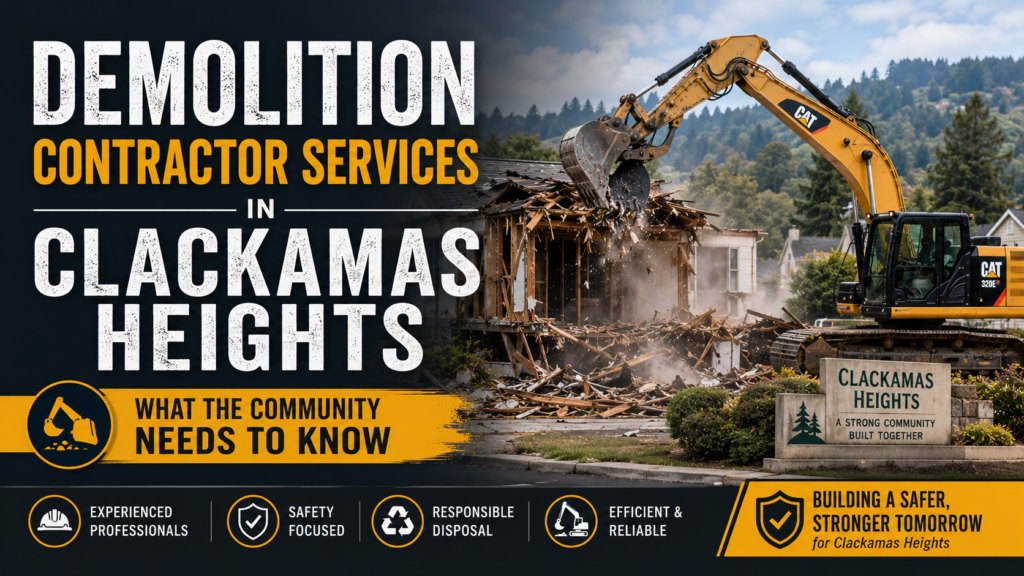
Clackamas Heights is a neighborhood in Oregon City, Clackamas County, Oregon, with a history stretching back to the 1940s. Located within the Park Place neighborhood of Oregon City just two miles from downtown the Clackamas Heights public housing community was established and operated by the Housing Authority of Clackamas County (HACC) for decades as one of Oregon’s oldest continuously operated public housing sites. The 16-acre community, which originally housed 100 units built in the 1940s, has been the subject of a major redevelopment effort by HACC, with plans to transform the site into a vibrant, mixed-income community of up to 300 modern affordable homes, along with new green spaces, improved infrastructure, and community amenities.
This significant redevelopment project along with the broader residential and commercial growth that characterizes Oregon City and Clackamas County places Demolition Contractor Clackamas Heights services at the center of the community’s construction story. Understanding how demolition contracting works, what standards govern it, and why skilled execution matters provides important context for residents, property owners, and stakeholders throughout the Clackamas Heights area.
What Demolition Contractors Do
A demolition contractor is a licensed professional who specializes in the controlled, systematic removal of structures or structural components. Their work encompasses far more than the act of physical destruction it includes detailed site assessment and planning, environmental survey and hazardous material abatement, utility disconnection coordination, selective or total structural demolition, debris management and recycling, and site preparation for subsequent construction.
In the context of a community like Clackamas Heights, demolition is the essential first phase of redevelopment. Before new mixed-income housing, green spaces, and community infrastructure can be built, the existing structures must be carefully and responsibly removed. The demolition phase sets the physical and environmental foundation for everything that follows, and its quality in terms of thoroughness, safety, and environmental responsibility directly affects the timeline and success of the entire redevelopment project.
Demolition in Redevelopment Contexts
Community redevelopment projects like the Clackamas Heights transformation present distinctive demolition challenges that differ from typical residential or commercial demolition work. When an entire neighborhood of structures is being cleared and rebuilt, demolition contractors must coordinate across multiple buildings and building systems simultaneously. They must manage the sequencing of demolitions to maintain access routes and safety perimeters, ensure that utility infrastructure is properly decommissioned or rerouted, and minimize disruption to neighboring properties and residents.
Redevelopment demolition also requires close coordination with planning authorities, environmental agencies, and community stakeholders. Oregon’s regulatory environment including rules administered by the Oregon Department of Environmental Quality (DEQ), Oregon’s State Historic Preservation Office (SHPO), and local Clackamas County and Oregon City planning bodies establishes requirements that must be met at each phase of demolition and site preparation work.
Hazardous Materials in Older Structures
One of the most significant technical challenges in demolishing structures built in the 1940s, as is the case with much of the original Clackamas Heights development, is the management of hazardous materials. Construction practices and material standards of the mid-twentieth century routinely incorporated materials that are now known to pose serious health risks if disturbed during demolition.
Asbestos is the most widely recognized hazardous material concern in structures of this era. Asbestos-containing materials (ACMs) were used extensively in floor tiles and the adhesives beneath them, pipe and duct insulation, roof felts and shingles, exterior siding panels (particularly the “transite” panels common in wartime housing), textured ceiling coatings, and joint compound. Under Oregon’s regulatory framework, a licensed asbestos inspector must conduct a pre-demolition survey of any structure that may contain ACMs. If ACMs are identified, they must be removed by a licensed asbestos abatement contractor in accordance with Oregon DEQ and federal EPA standards before mechanical demolition can begin.
Lead-based paint is another common concern in pre-1978 structures. Lead paint abatement is required when renovation or demolition work will disturb painted surfaces in structures where children may be present, and Oregon’s renovation, repair, and painting rules establish specific requirements for contractor certification, work practices, and waste disposal. Experienced demolition contractors in Clackamas County navigate these regulatory requirements as a matter of course.
Underground storage tanks (USTs), if present from prior fuel storage or other industrial uses of a site, require specialized removal procedures under Oregon DEQ oversight. Soil contamination associated with UST leakage may also require remediation before site development can proceed.
Selective vs. Total Demolition in Residential Communities
Demolition contractors working in residential community contexts may be engaged for either total demolition the complete removal of structures down to their foundations or selective demolition, which involves the targeted removal of specific structural elements while leaving others intact.
In a full redevelopment scenario like Clackamas Heights, total demolition is the primary mode of work. Each existing structure must be fully cleared from the site to make way for new construction. This typically involves coordinating the removal of all structural components walls, roofs, floors, foundations along with all site improvements such as driveways, walkways, fencing, and utility connections. The goal is a clean, prepared site that provides an appropriate starting point for new foundation and construction work.
Selective demolition, by contrast, plays a role when existing structures are being renovated or reconfigured rather than fully replaced. Interior strip-outs removing specific walls, flooring systems, kitchens, bathrooms, or mechanical systems are common in residential renovation projects throughout Oregon City and the broader Clackamas County area. These targeted demolitions require precision and care to preserve the structural integrity of the building shell and the condition of adjacent spaces.
Structural Safety During Demolition
Professional demolition contractors approach every project with structural safety as the paramount concern. Before demolition begins, a thorough structural assessment is conducted to identify potential hazards load-bearing elements that, if removed incorrectly, could cause unexpected collapse; weakened structural members from age, deterioration, fire damage, or pest damage; and underground voids or deteriorated foundations that could present instability during mechanical demolition.
Demolition workers are exposed to unique hazards not found in other construction trades: falling debris, dust and particulates, hazardous materials, unstable structural remnants, and the risk of unintended collapse. Oregon OSHA (OR-OSHA) establishes comprehensive safety requirements for demolition work, covering everything from worker training and personal protective equipment to structural bracing, ladder safety, and emergency procedures. Reputable demolition contractors maintain current OR-OSHA compliance as a non-negotiable operational standard.
Environmental Responsibility in Demolition
Oregon has long been a leader in environmental stewardship, and demolition contractors working in Oregon City and Clackamas County are expected to reflect that commitment in their waste management practices. Rather than routing all demolition debris to landfill, responsible contractors sort and divert recyclable and reusable materials. Concrete rubble is crushed and recycled as aggregate. Metals structural steel, rebar, copper plumbing, aluminum fixtures are sorted and sold for scrap recycling. Clean dimensional lumber may be donated to salvage outlets or reuse organizations. This material diversion reduces landfill burden and aligns with the environmental principles that guide Oregon’s approach to construction and development.
The Oregon DEQ establishes construction and demolition debris management requirements, and demolition contractors must document their debris diversion efforts in many project contexts. For a significant redevelopment project like Clackamas Heights, this documentation is an important part of demonstrating regulatory compliance and community accountability.
The Role of Demolition in Community Revitalization
In communities like Clackamas Heights that are undergoing planned revitalization, demolition plays a profoundly constructive role not a destructive one. Clearing aging, deteriorated structures creates the opportunity to build housing that meets contemporary standards for energy efficiency, accessibility, safety, and quality of life. The Clackamas Heights redevelopment vision includes 200 to 300 modern affordable homes designed for households of all sizes, new green spaces and recreational areas, improved neighborhood infrastructure, and community amenities shaped by resident and community input.
Achieving that vision begins with the demolition phase being executed to the highest professional standards safely, responsibly, on schedule, and in full compliance with Oregon’s regulatory requirements. Experienced demolition contractors understand the weight of this responsibility and approach community redevelopment projects with the care and commitment they deserve.
Conclusion
Clackamas Heights stands at an exciting and significant moment of transition moving from an aging mid-twentieth-century public housing development to a vibrant, modern mixed-income community. Demolition contractors play an indispensable role in this transformation, providing the technical expertise, environmental responsibility, and regulatory compliance that responsible site clearance requires. As the Clackamas Heights redevelopment moves forward, the quality of demolition work will be foundational to building something truly worthy of Oregon City’s legacy as a community that has always been willing to reinvent itself.