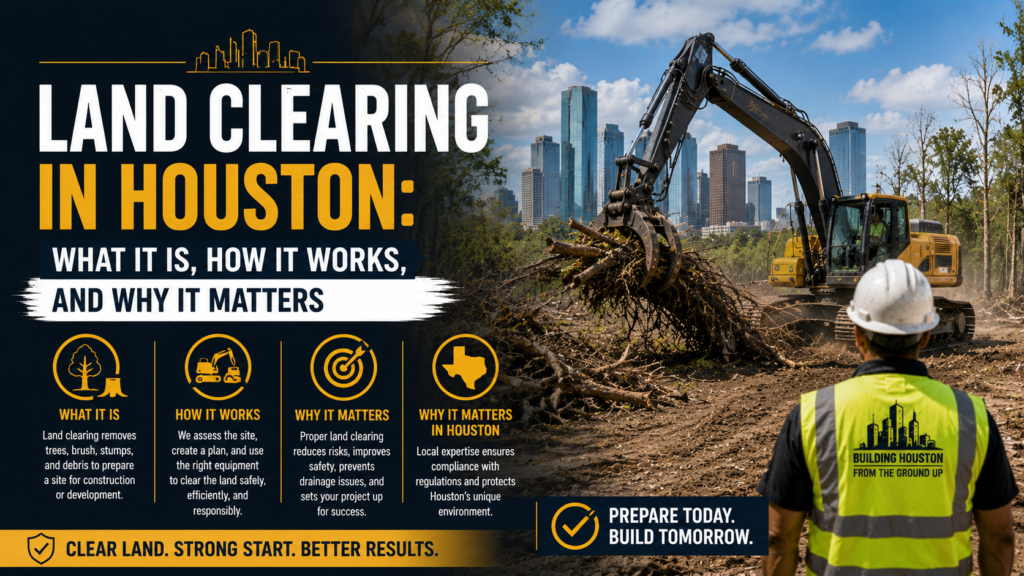
Houston is one of the fastest-growing metropolitan areas in the country, and that growth means one thing above all else: land is constantly being transformed. Raw lots are being prepared for new homes. Overgrown parcels are being cleared for commercial development. Farmland on the urban fringe is being converted for residential use. And properties affected by flooding, storm damage, or years of neglect are being restored to productive use. In every one of these scenarios, Land Clearing Houston is the essential first step.
Land clearing is the process of removing trees, brush, shrubs, stumps, roots, and other vegetation as well as any debris or structures from a parcel of land to prepare it for its intended use. It is both a practical necessity and, when done properly, a service that improves a property’s safety, appearance, usability, and value. Understanding what land clearing involves, the methods used, and the specific considerations relevant to the Houston area helps property owners and developers approach these projects with clear expectations.
Why Land Clearing Is Necessary
Construction and Development Preparation is the most common reason for land clearing in the Houston area. Before any structure can be built, the site must be cleared of all vegetation and organic material. This is not merely about aesthetics organic material left in the ground beneath a foundation will decompose over time, creating voids that cause foundation settlement and structural instability. Tree roots left in place after clearing can continue to grow, interfering with foundations, underground utilities, and drainage structures. A thorough clearing and grubbing operation removes not just the above-ground vegetation but the root systems beneath the surface, ensuring a clean and stable substrate for construction.
Invasive Species Control is an important but often overlooked application of land clearing in Texas. With over 150 invasive plant species present in the state, properties left unmanaged can become dominated by aggressive non-native plants such as Chinese tallow, Japanese privet, and giant reed. These species crowd out native vegetation, disrupt local ecosystems, and can make a property nearly unusable over time. Regular land clearing to control invasive species protects both the ecological health and the practical usability of a property.
Fire Hazard Reduction is a significant concern for properties with dry, overgrown vegetation particularly those in areas transitioning between developed and undeveloped land on Houston’s suburban and rural fringe. Creating cleared perimeters and firebreaks through strategic land clearing reduces the fuel available for wildfires and provides a margin of safety for structures and people.
Property Value Enhancement is a direct benefit of land clearing. A heavily overgrown, brushy, or debris-covered property is difficult to assess, market, or develop. Clearing the land allows potential buyers, developers, or appraisers to see and evaluate the property accurately, often revealing its full potential and increasing its marketability.
Pest and Vermin Control is another practical benefit. Dense vegetation and accumulated debris create habitat for rodents, venomous snakes, fire ants, and other pests that are common in Houston’s subtropical climate. Clearing overgrown areas eliminates the shelter and nesting conditions that support these populations.
Methods of Land Clearing
Mechanical Clearing using bulldozers and excavators is the traditional approach for large-scale clearing projects, particularly those where structures will be built on the cleared land. Bulldozers push over and uproot trees, clearing the ground while also removing the root ball a critical requirement for sites where foundations will be poured. Excavators provide more precision for selective clearing, allowing specific trees or areas to be targeted while leaving others untouched. This method is highly effective but involves significant soil disturbance, which may require erosion control measures and grading work after clearing is complete.
Forestry Mulching has become one of the most popular land clearing methods in the Houston area for projects where the ground will not be immediately covered by a foundation. A forestry mulcher a specialized piece of equipment fitted with a rotary drum or disc covered with carbide teeth grinds standing trees, shrubs, and brush directly into a fine mulch that is deposited on the ground surface. This method is fast, cost-effective, and environmentally beneficial: the mulch layer it leaves behind prevents soil erosion, retains moisture, and decomposes to improve soil health over time. Forestry mulching is particularly well-suited for creating firebreaks, controlling invasive species, preparing pastureland, and clearing sites where only surface vegetation needs to be removed. It is not appropriate for sites where foundations will be constructed directly, as stumps must be fully removed from the ground in those applications.
Manual Clearing using hand tools and small equipment is appropriate for small areas, tight spaces where large machinery cannot access, or sites with sensitive features that must be protected. It is labor-intensive and slower than machine-based methods, but allows for precise control over exactly what is removed and what is left in place.
The Clearing and Grubbing Process
A complete land clearing project typically involves two phases: clearing and grubbing. Clearing refers to the removal of all above-ground vegetation and structures. Grubbing refers to the subsequent removal of below-ground material stumps, root systems, and organic subsoil that was not addressed during the clearing phase. For construction sites, grubbing is essential, as any organic material left in the ground beneath a structure will decompose and cause settlement problems over time.
After clearing and grubbing, the site typically requires rough grading to level the disturbed areas and establish proper drainage patterns before construction can begin. The combination of clearing, grubbing, and grading is often referred to collectively as site preparation, and it is frequently performed by a single contractor with the equipment and expertise to handle all three phases efficiently.
Houston-Specific Considerations
Houston’s climate and ecology create specific considerations for land clearing projects. The subtropical climate supports extremely dense and fast-growing vegetation a cleared site can become heavily overgrown again within a single growing season if maintenance is not maintained. Timing land clearing appropriately relative to the construction schedule is important to ensure that the cleared site remains usable.
Houston’s heavy clay soils are particularly susceptible to erosion when exposed by clearing. Clearing large areas without implementing erosion control measures silt fences, erosion control blankets, temporary seeding can result in significant topsoil loss and sediment runoff into drainage channels. The City of Houston and Harris County have stormwater management requirements that apply to land disturbance projects above certain thresholds, and a reputable clearing contractor operates in compliance with these requirements.
Permit requirements for tree removal vary across Houston and Harris County. Certain tree species are protected under the City of Houston’s tree ordinance, and removal of qualifying protected trees requires a permit. Working with a land clearing contractor familiar with local regulations ensures that the clearing work is performed legally and that any required mitigation such as tree replacement is planned for appropriately.
Connecting Land Clearing to the Larger Project
Land clearing is rarely the final step in a property improvement process it is the first. After the site is cleared, excavation and grading follow, then utility installation, then foundation work, then construction. Each of these phases depends on the previous one being done correctly. A land clearing contractor who understands how their work connects to the broader project sequence performs their clearing and grubbing with that context in mind, leaving a site that is ready to move seamlessly into the next phase without delays or rework.
Final Thoughts
Land clearing in Houston is a foundational service for one of the country’s most active construction and development markets. Whether you are preparing a raw lot for a new home, controlling invasive vegetation on a rural parcel, creating a firebreak on a large property, or restoring a neglected site to productive use, professional land clearing with the right methods and equipment makes the work efficient, safe, and properly positioned for whatever comes next. Understanding the process from the methods and equipment involved to Houston’s specific climate and regulatory considerations puts property owners and developers in the best position to plan their projects effectively.